2026-09-14
Understanding Under-Eye Fat Repositioning and Lower Blepharoplasty
A comprehensive guide on under-eye fat repositioning and lower blepharoplasty, detailing surgical techniques for different skin laxity levels, costs, recovery times, and expected outcomes.
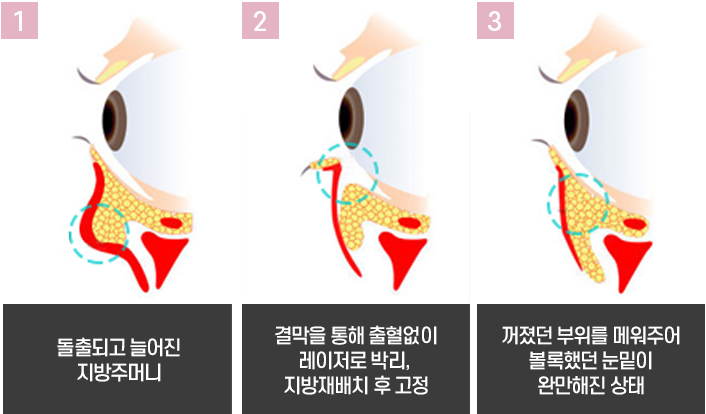

What Is Under-Eye Fat Repositioning?

Under-eye fat repositioning corrects protruding or sagging under-eye areas caused by fat, creating a brighter and more youthful eye appearance.
In many cases, prominent under-eye fat can make a person look older.
The under-eye area may appear bulging, and in some instances, pigmentation combined with fat protrusion causes severe dark circles.
If under-eye fat makes you look tired or unwell, under-eye fat repositioning can brighten the under-eye area and create a revitalized, vibrant expression.
Surgical Methods for Under-Eye Fat Repositioning
The surgical approach varies depending on the degree of skin laxity.
1. Cases Without Skin Laxity |
When there is no skin sagging,
(typically the case for younger individuals),
the procedure is performed transconjunctivally (through the inside of the eyelid), leaving no visible external scars.
In most cases, simple fat removal is sufficient.
However, if there is a distinct demarcation line around the fat pads,
the under-eye fat may be repositioned,
and if there are hollow areas, fat grafting may also be performed as needed.
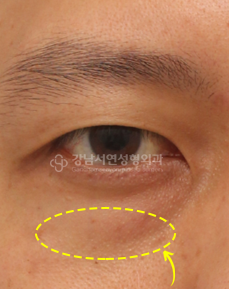
The yellow highlighted area in the image above shows where the tear trough ligament is released and where fat repositioning will take place.
By releasing the tear trough ligament, the boundary between the fat pad and the hollow is smoothed out, and the fat is appropriately repositioned.
2. Cases With Skin Laxity (Skin sagging present alongside fat protrusion) |
When skin sagging is present alongside protruding fat,
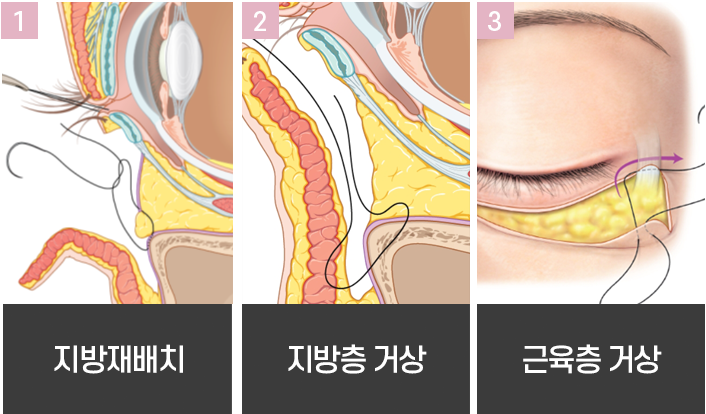
the excess skin is excised and sutured after repositioning or removing the fat.
The procedure is technically straightforward;
however, if severe shadowing and deep hollows exist beneath the bulging fat,
fat grafting can be performed concurrently with under-eye fat repositioning.
Additionally, a SOOF lift (sub-orbicularis oculi fat lift, part of a midface lift) may be carried out.
In other words, in these cases, under-eye fat repositioning requires a tailored, multi-step approach.
Limitations of the Surgery
(1) Even when an external incision is made, scars fade significantly over time. Every effort is made to preserve any existing natural under-eye fullness (aegyo-sal).
However, if pre-existing asymmetry existed or if there was no natural fullness to begin with, asymmetry may persist. Fine wrinkles will also remain.
(2) If excessive skin is excised, the lower eyelid may pull downward or turn outward (ectropion), requiring great care. Excessive scarring or nerve damage can worsen this pulling, making meticulous surgical precision essential.
Therefore, it is crucial to undergo surgery with an experienced, board-certified plastic surgeon.
Candidates for Under-Eye Fat Repositioning / Blepharoplasty
- Individuals with protruding fat beneath the eyes
- Individuals looking tired or dull due to dark circles
- Individuals with hollow and shadowed under-eye areas
- Individuals who look older due to fine under-eye wrinkles
- Individuals appearing aged due to bulging under-eye fat
Procedure Duration and Cost Information
The surgery typically takes about 1 hour and is completed within 1 hour and 30 minutes at most.
Initial swelling generally subsides within 1 to 2 weeks, and scars are barely noticeable.
Costs for under-eye fat repositioning (dark circle correction) vary across clinics.
A transconjunctival approach usually ranges between 1,000,000 and 2,000,000 KRW, while an external subciliary incision method ranges from 1,200,000 to 3,500,000 KRW.
Revision surgeries may incur higher costs, so please consult the clinic directly for an accurate estimate.





Frequently Asked Questions
Will there be visible scarring after under-eye fat repositioning?
When there is no skin laxity and the procedure is performed transconjunctivally (inside the lower lid), no external scar remains. Even if an external skin incision is required due to significant skin sagging, the scar becomes virtually invisible over time.
How long does the surgery take, and how long does recovery take?
The surgery typically takes 1 to 1.5 hours, and major swelling subsides within 1 to 2 weeks. Transconjunctival incisions carry minimal scarring concerns, and any incision lines fade smoothly during the healing process.
What is the approximate cost of under-eye fat repositioning?
Transconjunctival procedures generally cost between 1,000,000 and 2,000,000 KRW, while external skin excision approaches range from 1,200,000 to 3,500,000 KRW. Prices vary by clinic, and revision surgeries are typically more expensive.
Will fine under-eye wrinkles and natural fullness (aegyo-sal) be completely improved?
No, not all wrinkles will disappear, and fine superficial wrinkles may persist. While surgeons strive to preserve natural fullness, pre-existing asymmetry or an absence of baseline fullness may result in persistent asymmetry post-surgery.
What potential complications should I be aware of with this surgery?
Excision of excessive skin can cause lower lid retraction or ectropion (eye turning outward). Excessive internal scarring or nerve injury may worsen this condition, making it vital to choose an experienced, board-certified plastic surgeon.