2026-10-27
Short Nose Correction (Upturned Nose Surgery)
A clinic guide to short nose (upturned nose) correction, covering nasolabial angle criteria, candidate cases, and surgical options such as septal extension grafting.
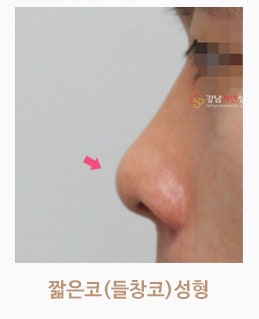


A short nose, where the tip rises upward and the nostrils are prominently visible, is commonly known as an upturned nose.
Surgery that relaxes the nasal tip cartilage and gently lowers it to lengthen the nose is called short nose correction (upturned nose surgery).
This is an advanced procedure that uses septal extension grafting to lengthen the nose, and various surgical techniques must be tailored to each individual's condition.


What is the ideal nasal angle?

An upturned nose, also called a lifted nose or pig nose, is characterized by nostrils that are prominently visible from the front, making the nose look short.
When viewed from the side, an upturned nose has a nasolabial angle of 110 to 150 degrees or more, with the nose tip lifted, so the nostrils are also clearly visible from the front.
An upturned nose is also called a "pig nose" and can easily give an unrefined, old-fashioned impression.
Generally, when the angle between the nose tip and the upper lip is 95 to 105 degrees, the nose is considered beautiful.
Cases That Call for Short Nose (Upturned Nose) Correction
The nose is short and the tip appears upturned | ||
The nostrils are prominently visible from the front | ||
Congenital underdevelopment of the nasal bone, cartilage, or skin | ||
The upper lip is long | ||
An upturned nose caused by inflammation from implant contracture after nose surgery |
Short Nose (Upturned Nose) Surgical Methods
Some cases require an osteotomy, while others may use techniques that shave down protruding areas and fill in recessed ones.
When combined with other nose procedures, the shape of artificial implants, such as silicone, may be varied,
or materials such as cartilage grafts or artificial dermis may be used to correct misaligned areas.
There are various surgical techniques available.
When the nose is upturned (nasolabial angle of 110 degrees or more)

The skin and soft tissue are separated from the raised nasal tip,
then the tip is fixed downward to correct it so the cartilage appears longer.
When the nasal cartilage is short

The alar cartilage is separated from the upper lateral cartilage
and pulled downward. Cartilage is then grafted into the empty space created in between
(septal extension graft), and the repositioned cartilage is
secured in place.

Other Nose Procedures (Crooked Nose, Hump Nose, Nasal Tip, Autologous Dermal Graft Rhinoplasty)


Frequently Asked Questions
What is short nose correction?
Short nose correction is a surgery that relaxes the nasal tip cartilage and gently lowers it to lengthen the nose. It corrects an upturned nose, where the tip lifts upward and makes the nose look short, and is also called upturned nose surgery.
How is an upturned nose assessed?
From the side, a nasolabial angle of 110 degrees or more is considered an upturned nose. Generally, an angle of 95 to 105 degrees between the nose tip and the upper lip is considered a beautiful nose. When the nostrils are prominently visible from the front, the nose looks short.
When is short nose correction needed?
It may be needed when the nose is short with an upturned tip, or when the nostrils are prominently visible from the front. It also applies to cases caused by congenital underdevelopment of the nasal bone, cartilage, or skin, a long upper lip, or an upturned nose resulting from inflammation caused by implant contracture after nose surgery.
What methods are used for short nose correction?
Surgical methods vary depending on each person's condition. They include osteotomy and techniques that shave down protruding areas and fill in recessed ones. When the nasal tip is raised, it is corrected by fixing it downward. When the nasal cartilage is short, the alar cartilage is separated and cartilage is grafted into the empty space.
Is short nose correction a high-difficulty surgery?
Yes, it is described as a highly advanced procedure that uses septal extension grafting to lengthen the nose. It explains that various surgical techniques must be applied according to each person's condition.