2026-09-24
Epicanthoplasty Revision / Epicanthoplasty Restoration
Discover epicanthoplasty revision and reconstruction techniques, ideal inner corner proportions, and corrective methods for over-excised epicanthal folds.
Epicanthoplasty Revision / Epicanthoplasty Restoration

2018. 8. 1. 18:36

What is the ideal intercanthal distance for Asians?
The most ideal intercanthal (between the eyes) distance for Asians is considered to be 3.48–3.6 cm on average,
while reports show that Miss Universe contestants have an average distance of 3.17 cm.
Because the golden ratio of beauty varies depending on overall facial proportions, such as face size and eye size, the distance between the eyes alone is not the sole determinant.
However, the horizontal length of Korean eyes is typically around 2.8–2.9 cm on average,
and achieving around 3.1–3.2 cm results in a clear, well-defined look.

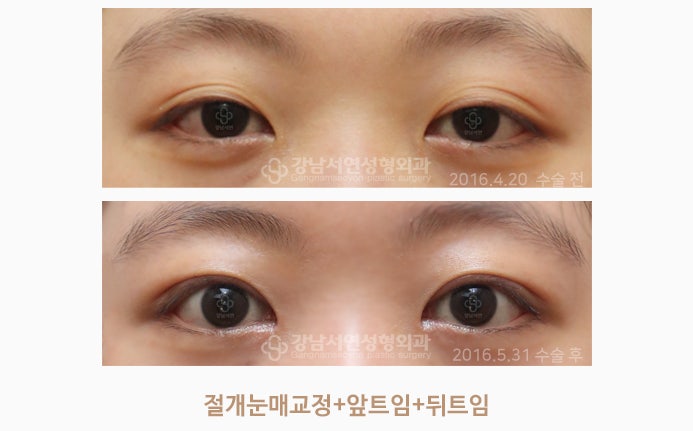
This is typical intercanthal spacing for Asians. (This case underwent incisional ptosis correction + medial epicanthoplasty + lateral epicanthoplasty.)
The reddish, exposed protrusion in the inner corner is called the lacrimal lake (caruncle area).
Generally, exposing about 50% to under 90% of the lacrimal lake (average 60–80%) looks natural,
and leaving at least 0.5 mm of the Mongolian fold preserves a natural look while effectively concealing scars after epicanthoplasty.
What is Epicanthoplasty Restoration / Epicanthoplasty Reconstruction?
Epicanthoplasty restoration (reconstruction) is performed
when epicanthoplasty has been overdone—
that is, when the reddish tissue,
the lacrimal lake, is excessively exposed—
to restore and reconstruct this area through revision surgery.
The restoration case below will be explained based on a presentation delivered to plastic surgery specialists titled,
'Epicanthoplasty Restoration Surgery Using the Transposition Flap Technique.'
This surgical method effectively minimizes epicanthoplasty scarring.
Epicanthoplasty Restoration Case (Female)

▲ Patient in need of epicanthoplasty restoration
Epicanthoplasty Restoration Case (Male)

▲ In the male patient shown above, following epicanthoplasty at another clinic,
excessive exposure of the lacrimal lake is clearly visible.
Through epicanthoplasty restoration (reconstruction/revision),
it is evident that more than half of the lacrimal lake has been covered naturally.
Precautions for Reconstructive Surgery
To prevent another surgical failure,
reconstructive surgery must be approached with great care!
While some hear that they have become much more attractive after double eyelid surgery, others hear that they looked better before the operation.
There are multiple reasons, but in most cases, the main factor lies in the horizontal width of the eyes.
In other words, individuals with longer eye widths achieve exceptional results from double eyelid surgery, whereas those with shorter widths may not.
Because the success of double eyelid surgery is largely influenced by one's innate eye width,
many plastic surgeons have devoted extensive research and development to surgical techniques that widen the eyes.
However, when the eye width is excessively lengthened or the epicanthal fold (Mongolian fold) is over-excised—leaving excessive red flesh exposed—
it can impart a harsh, unnatural appearance, making reconstructive revision necessary.
Because there should never be a second surgical failure, epicanthoplasty reconstruction requires careful research and prudent decision-making.
Epicanthoplasty Reconstruction Surgical Method

1. Design a V-Y advancement flap at the medial canthus.

2. Close the V-Y advancement flap.

3. Design the Z-plasty.

4. Perform the Z-plasty.
For epicanthoplasty reconstructive surgery,
stitch removal takes place around one week after the procedure,
and surgery time takes approximately 20 to 30 minutes.
Anesthesia is administered via local anesthesia or conscious sedation.

Dr. Dong-il Choi of Gangnam Seoyeon Plastic Surgery Clinic
received professional recognition for his expertise in epicanthoplasty reconstruction
with his presentation on Mongolian fold reconstruction using the V-Y turnover flap
at the 'Gangnam Symposium' held at Yonsei Severance Hospital in June 2014.
If you have any further questions,
please feel free to reach out via Naver TalkTalk,
and we will gladly provide detailed answers.


Frequently Asked Questions
When is epicanthoplasty restoration surgery needed?
It is indicated when excessive epicanthoplasty exposes too much of the red lacrimal lake or causes a harsh facial appearance. When the lacrimal lake is overly visible or noticeable scarring remains, reconstructive revision helps restore a soft, natural inner eye contour.
What is the ideal lacrimal lake exposure ratio for a natural look?
Generally, exposing between 50% and under 90% (average 60–80%) of the lacrimal lake appears most natural. Preserving at least 0.5 mm of the Mongolian fold is also recommended to maintain natural contours and conceal scars.
How long does the surgery take and what anesthesia is used?
The surgery takes approximately 20 to 30 minutes. It is performed comfortably under local anesthesia or conscious sedation.
When are the stitches removed following epicanthoplasty restoration?
Stitches are typically removed approximately one week after the surgical procedure, followed by routine monitoring of the healing process.