2026-10-03
Autologous Dermal Rhinoplasty
Explains autologous dermal rhinoplasty, which uses your own dermis from the buttock or groin, and compares it with silicone, Silitex, autologous cartilage, and artificial dermis.


Autologous Dermal Rhinoplasty: Let's take a look at rhinoplasty using your own autologous dermis.
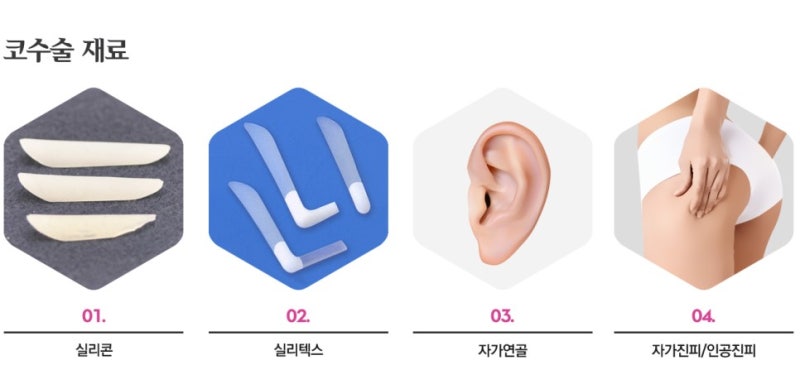
There are four types of surgical materials used in rhinoplasty,
as listed below.

Silicone is currently the most widely used material in nasal surgery. It has received FDA approval in the United States and is a safe product that is harmless to the human body. It does not change or get absorbed inside the body, and compared to Gore-Tex, it allows for more precise shaping.
Silitex is a product developed to combine the strengths of silicone and Gore-Tex while offsetting their weaknesses. It has been approved as a safe product by the Korea Food and Drug Administration (KFDA) and is harmless to the body. Silicone, which is easy to shape, is designed into the desired form first, and then Gore-Tex is attached, making it easy to shape while naturally raising the nasal tip.
Autologous cartilage refers to using your own ear cartilage or septal cartilage. Anatomically, the lower part of the nose is made up of cartilage, which makes ear cartilage and septal cartilage excellent materials. Because they are your own tissue, the likelihood of complications such as inflammation is nearly nil, and they stand out compared to other materials in terms of foreign body reaction, feel, and absorption rate. However, an additional surgery is required to harvest the cartilage.
Autologous dermis uses skin from the buttock or groin and is used in secondary surgeries to address complications caused by silicone. Artificial dermis is made by processing human dermis to eliminate rejection reactions. Its advantages are that it is not easily absorbed over time and is soft without a fixed shape, so it is often used in place of ear cartilage to raise the nasal tip. It allows the shape of the nasal tip to be soft and full.
Autologous dermal rhinoplasty is sometimes used for first-time surgery patients,
but it is most commonly used in revision surgeries.
You will be recommended autologous dermal rhinoplasty
if you receive a diagnosis like the following:

01. When revision surgery using a previously placed implant
shows recurring inflammation

02. When the current implant is visible through the skin,
looks artificial, and the skin is thin

03. When an allergic reaction develops to the implant

The photo above shows dermis harvested from the buttock,
which is used in rhinoplasty in place of an implant.
This is what is called autologous dermal rhinoplasty.

This is a photo after a female rhinoplasty using autologous dermis.
For autologous dermal rhinoplasty, it is important to have the surgery tailored to your own face and proportions.
We strongly recommend consulting with a board-certified plastic surgeon.


Frequently Asked Questions
In what cases is autologous dermal rhinoplasty usually performed?
It is most often performed during revision surgery caused by implant complications. Autologous dermis is used when an existing implant repeatedly causes inflammation, when the implant shows through thin skin, or when an allergic reaction to the implant develops.
From which part of the body is autologous dermis harvested?
It is usually harvested from the skin of the buttocks or groin. The harvested autologous dermis is safely used in place of artificial implants on the nasal bridge or other areas of the nose.
What are the advantages of autologous cartilage used in rhinoplasty?
Because it is your own tissue, the risk of side effects such as inflammation is nearly nil. Ear cartilage or septal cartilage is used, and it causes minimal foreign body reaction and offers excellent feel, although an additional surgery is required to harvest it.
What is the difference between artificial dermis and autologous dermis?
Artificial dermis is an artificial material made by processing human dermis to eliminate rejection reactions. It is not easily absorbed over time and is soft, so it is sometimes used in place of ear cartilage to create a fuller nasal tip.