2026-11-04
Autologous Dermal Graft Rhinoplasty
Explains autologous dermal graft rhinoplasty using your own buttock or groin tissue, compares it with silicone, Silitex, cartilage and artificial dermis, and when it is used.

Autologous dermal graft rhinoplasty: Let's take a look at nose surgery using your own dermal tissue.
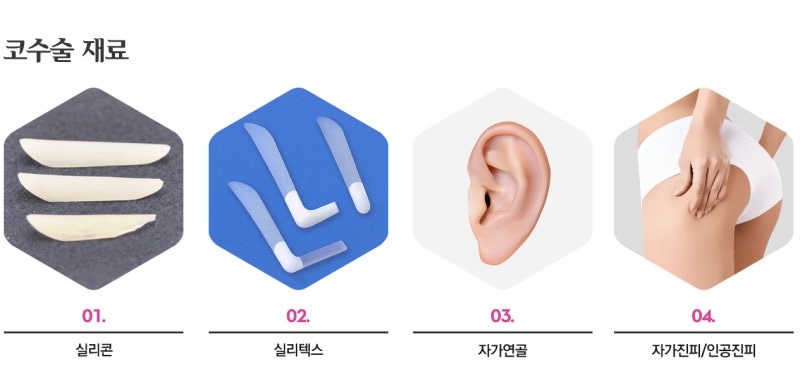
Four types of materials are used in rhinoplasty,
as shown below.

Silicone is currently the most widely used material in nose surgery. It has been approved by the U.S. FDA and is a safe product that is harmless to the body. It does not change or get absorbed inside the body, and it allows for more precise shaping than Gore-Tex.
Silitex is a product developed by combining the strengths of silicone and Gore-Tex while compensating for their weaknesses. It has been approved by Korea's Ministry of Food and Drug Safety as a safe product that is harmless to the body. The silicone is shaped first and then Gore-Tex is attached, which makes it easy to shape while naturally raising the nose tip.
Autologous cartilage involves using your own ear cartilage or septal cartilage. Anatomically, the lower part of the nose is made of cartilage, so ear and septal cartilage make excellent materials. Because they are your own tissue, there is almost no risk of side effects such as inflammation, and they outperform other materials in terms of foreign-body reaction, feel, and absorption rate. However, an additional surgery is required to harvest the cartilage.
Autologous dermal graft uses skin from the buttock or groin and is used in revision surgeries needed because of silicone side effects. Artificial dermis is made by processing human dermis to remove its rejection response. Its advantages are that it is not easily absorbed over time and has no fixed shape, so it stays soft. It is often used in place of ear cartilage to raise the nose tip, and it can give the nose tip a soft and full shape.
Autologous dermal graft rhinoplasty
may sometimes be used for first-time surgeries,
but it is most commonly used in revision surgeries.
If you are diagnosed with any of the following conditions, nose surgery using an autologous dermal graft is performed.

01. When revision surgery on a previously placed implant
shows repeated inflammation

02. When the current implant shows through,
looks artificial,
and the skin is thin

03. When an allergic reaction to the implant develops

The photo above shows dermis harvested from the buttock,
which is used in place of an implant for nose surgery.
This is exactly what autologous dermal graft nose surgery is.

This is a photo taken after a female rhinoplasty using an autologous dermal graft.
When performing autologous dermal graft nose surgery, it is important to tailor the procedure to your own facial features and proportions.
We strongly recommend consulting a board-certified plastic surgeon.

